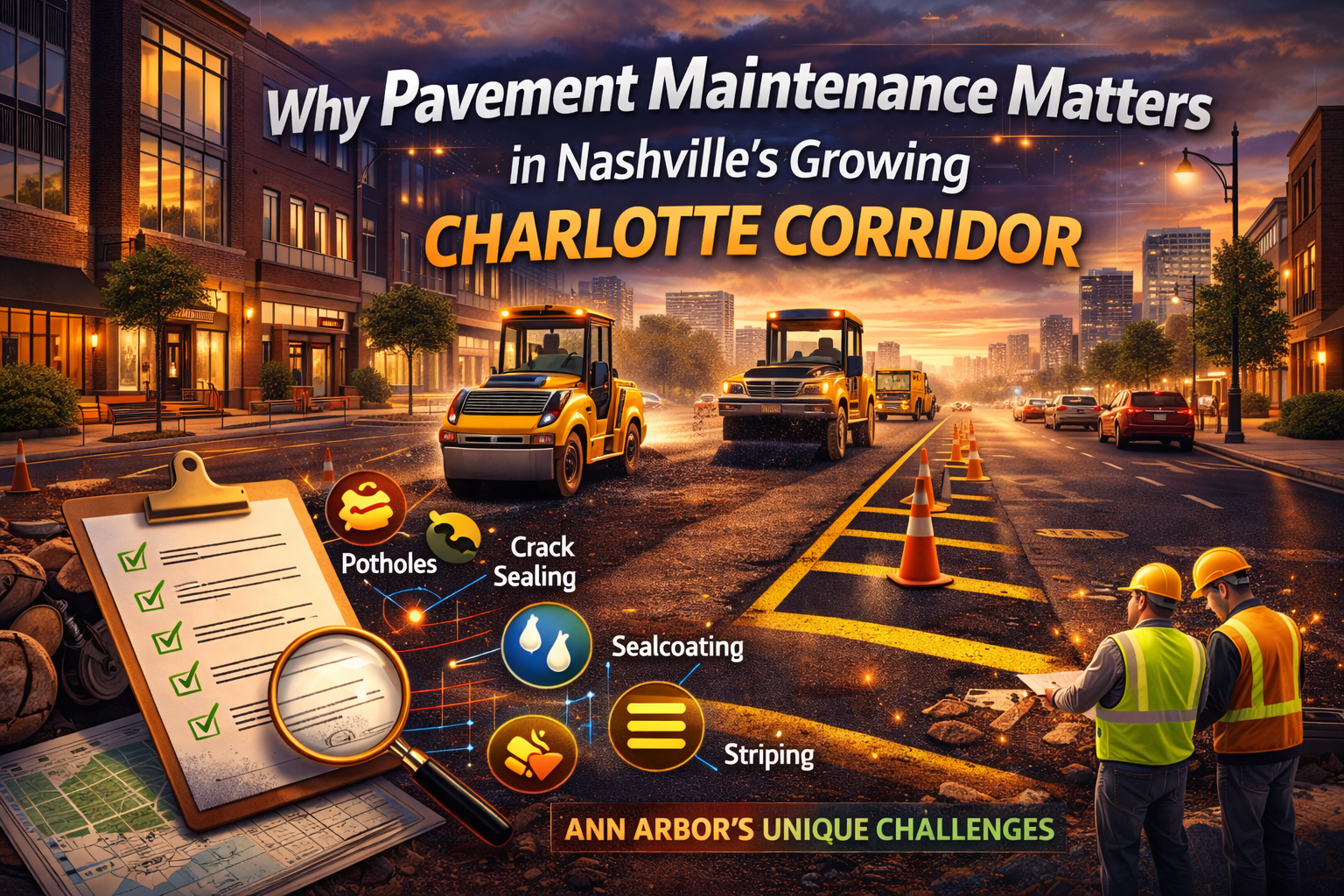
Nashville’s Charlotte Corridor has come a long way. Once a stretch of industrial warehouses and car lots, it has transformed into one of West Nashville’s most dynamic areas packed with local breweries, mixed-use developments, boutique shops, restaurants, and thriving residential communities like Sylvan Park and The Nations. With over 25,000 vehicles traveling Charlotte Avenue every day and major projects like ONEC1TY, Hill Center Sylvan Heights, and Sylvan Station drawing steady foot and vehicle traffic, the demand for well-maintained pavement has never been greater.
Whether you own a business, manage a commercial property, or oversee an HOA in this corridor, understanding how paving services work and why they matter is essential for protecting your investment, ensuring safety, and keeping your property looking its best in a neighborhood that’s growing fast.
What Does a Paving Contractor Actually Do?
Many property owners think of a paving contractor only when something is visibly broken a pothole, a crumbling driveway edge, or badly faded parking lot lines. But professional paving contractors offer a full spectrum of services that go far beyond emergency repairs.
A qualified paving contractor handles everything from new asphalt installation on undeveloped ground to ongoing preventative maintenance programs for existing surfaces. Their work typically covers:
- New asphalt paving laying fresh asphalt on prepared, compacted base material for driveways, parking lots, roads, and private lanes
- Sealcoating applying a protective coating over existing asphalt to guard against oxidation, water damage, and UV ray degradation
- Crack filling and sealing sealing surface cracks before water penetrates and weakens the pavement’s foundation
- Pothole repair and patching cutting out damaged sections and replacing them with fresh asphalt
- Milling and resurfacing removing the top layer of deteriorated asphalt and overlaying fresh material, a cost-effective alternative to full replacement
- Parking lot striping painting clearly visible lines, arrows, ADA symbols, fire lanes, and directional markings
- Asphalt grading and drainage ensuring proper slope and water runoff to prevent pooling and base erosion
In a dense, growing corridor like Charlotte Avenue, all of these services are regularly in demand as properties get redeveloped, parking lots age, and commercial foot traffic increases.
The Science Behind Asphalt Deterioration
Understanding why asphalt breaks down helps explain why regular maintenance is so important. Asphalt is a petroleum-based material, and from the moment it’s laid, it begins a natural process of oxidation. Exposure to oxygen causes the binders within the asphalt to harden, turning a once-flexible, durable surface into something brittle and prone to cracking.
Here’s what accelerates that process:
UV Rays: Sunlight’s ultraviolet radiation breaks down the carbon bonds within asphalt. Over time, this causes the surface to fade from a rich black to a worn gray, and eventually leads to surface cracking. Tennessee summers are intense, and the Charlotte Corridor’s busy surface streets receive significant daily sun exposure.
Water Infiltration: This is the number one cause of asphalt deterioration. Even hairline cracks allow water to seep down into the base layer beneath the asphalt. When temperatures drop in winter and Nashville does see freezes that water expands as it freezes, pushing cracks wider from the inside out. This freeze-thaw cycle is one of the most destructive forces on any paved surface.
Vehicle Fluids: Because asphalt is petroleum-based, other petroleum products like gasoline and motor oil can chemically bond with it, softening the pavement and breaking it down from the surface. High-traffic commercial areas like parking lots on Charlotte Avenue particularly those adjacent to restaurants and businesses are especially vulnerable to oil stains and fuel drips.
Heavy Traffic Load: Consistent vehicle pressure, especially from delivery trucks or heavier commercial vehicles, accelerates wear on the surface and can create ruts or depressions over time, particularly when the underlying base hasn’t been properly prepared.
Sealcoating: Preventative Care for Asphalt Surfaces
One of the most important and cost-effective services a Paving Contractor Charlotte Corridor provides is sealcoating. Think of it as sunscreen for your pavement a protective barrier that slows the effects of oxidation, UV exposure, water penetration, and chemical damage.
Sealcoating involves applying a liquid coating typically coal tar emulsion or asphalt-based sealer to the surface of existing pavement. The material fills small surface voids in the asphalt, essentially creating an impermeable top layer that repels water and reduces the rate of deterioration.
How sealcoating is applied:
Before any sealer goes down, the surface must be thoroughly cleaned. Contractors use power blowers and heavy-duty brooms to remove all dirt, debris, and loose aggregate. Oil stains common in commercial parking lots require special treatment with primers or cleaners to ensure the sealant bonds properly. Any cracks or potholes must be addressed before sealing, since sealcoating is a maintenance treatment, not a repair solution.
The sealant itself can be applied using a squeegee, a spray wand, or a brush, depending on the surface area and any confined spaces that need special attention. Most professional applications involve at least two coats, with the second coat applied only after the first has properly cured. The surface needs to be kept clear of traffic for 18 to 36 hours after application.
How often should you sealcoat?
Most paving professionals recommend sealcoating every two to three years for standard commercial surfaces. High-traffic areas such as parking lots at retail businesses or restaurants may benefit from annual or biennial applications. The right schedule depends on the volume of traffic, the amount of sun exposure, and the local climate conditions.
For properties along Charlotte Avenue, where businesses draw consistent daily traffic, staying on a regular sealcoating schedule is one of the most effective ways to extend the life of a parking lot by years even decades.
Parking Lot Striping: More Than Just Lines
Parking lot striping is sometimes treated as an afterthought, but it plays a critical role in safety, compliance, and the overall impression your property makes on customers and visitors.
Fresh, clearly visible striping does several important things:
Improves traffic flow. Clearly marked lanes, directional arrows, and designated entry and exit points guide drivers through your parking area efficiently, reducing confusion and the risk of minor collisions.
Maximizes parking capacity. A well-planned striping layout whether angled or straight-in stalls ensures you’re getting the maximum number of spaces out of your available square footage. Faded or improperly marked lots often result in cars parking inefficiently, reducing the effective capacity of the lot.
Ensures ADA compliance. Federal and local regulations require designated accessible parking spaces with specific dimensions, access aisles, and the proper signage. A professional paving contractor ensures your striping meets current ADA guidelines, reducing your liability exposure.
Reduces liability. Faded or missing markings can contribute to accidents, injuries, and disputes on your property. If a customer or employee is injured because of unclear striping or an unmarked hazard, property owners can face significant legal and financial consequences.
Enhances curb appeal. Especially when paired with a fresh sealcoat, crisp white or yellow striping against a deep black surface gives any commercial property a polished, well-maintained appearance. In a competitive retail corridor like Charlotte Avenue, that first impression matters.
Striping should be refreshed every one to two years, though high-traffic areas may need touch-ups sooner. Professional contractors use commercial-grade solvent-based or thermoplastic paint designed to withstand weather and traffic without fading quickly.
Why the Charlotte Corridor Presents Unique Paving Challenges
Not every paving project is the same, and the Charlotte Corridor comes with some distinctive characteristics that local contractors need to understand.
High daily traffic volume. With over 25,000 vehicles traveling Charlotte Avenue daily, commercial properties along this corridor experience above-average wear on their paved surfaces. Parking lots that see dozens or hundreds of vehicle entries and exits each day deteriorate faster than those in lower-traffic areas.
Ongoing development and construction. The Charlotte Corridor has been in a sustained period of redevelopment. Construction traffic, heavy equipment, and delivery vehicles associated with nearby building projects can put additional stress on existing paved surfaces particularly older parking lots that haven’t been upgraded in years.
A mix of property types. The corridor hosts everything from boutique retail and restaurants to offices, residential buildings, and mixed-use developments. Each property type has different paving needs a restaurant parking lot deals with oil drips and high turnover traffic; an office complex needs clearly organized parking stalls and clean striping; a residential building needs smooth, safe driveways and walkways.
Nashville’s climate. Middle Tennessee experiences a full range of seasons, from hot and humid summers that accelerate UV-related asphalt degradation, to winter freezes that drive the destructive freeze-thaw cycle. A contractor familiar with this climate knows how to time projects appropriately paving and sealcoating, for instance, should be done in temperatures above 50°F for optimal curing.
Crack Filling vs. Full Replacement: Knowing the Difference
One of the most common questions property owners have is whether their pavement needs repair, resurfacing, or full replacement. A qualified paving contractor will assess the extent of damage before making a recommendation.
Crack filling is appropriate for isolated linear cracks narrow fissures that haven’t yet spread into large damaged areas. A rubberized crack filler is heated and poured into the crack, filling it completely and creating a flexible seal that expands and contracts with temperature changes. This stops water from getting in and prevents the crack from growing.
Mill and overlay (resurfacing) is the right choice when a parking lot shows widespread surface deterioration significant cracking, surface roughness, and general aging but the underlying base is still structurally sound. Milling removes the top layer of damaged asphalt, and a fresh layer is paved over the prepared surface. This is far more cost-effective than full replacement and gives the parking lot essentially a new life.
Full replacement is necessary when the damage extends through the asphalt into the base layer, causing structural failure widespread alligator cracking (which looks like a grid of interconnected cracks resembling reptile scales), significant settling, or large sinkholes. In these cases, the asphalt and base must be excavated and rebuilt from the ground up.
The general rule of thumb: if the damaged area covers more than 25–30% of the surface, resurfacing or replacement may be more practical than patchwork repairs.
Choosing the Right Paving Contractor in the Charlotte Corridor
Whether your property needs a fresh sealcoat, new striping, crack repair, or a full parking lot overhaul, working with an experienced local contractor is important. A contractor who understands Nashville’s climate, the specific demands of the Charlotte Corridor, and local regulations including ADA compliance requirements will deliver results that last.
Look for a contractor who offers a thorough site assessment before any work begins, provides clear documentation of what services are recommended and why, and stands behind their workmanship. For commercial properties on Charlotte Avenue, where appearance and functionality directly affect your business, cutting corners on pavement maintenance isn’t worth the long-term cost.
A well-maintained paved surface protects your investment, keeps customers and employees safe, and ensures your property presents the best possible face to one of Nashville’s fastest-growing neighborhoods.